RECA.help
Downwinder Claims: Eligibility & Documentation Guide
Filing a successful Downwinder claim requires proving physical presence in designated areas during specific mid-century atmospheric testing windows, along with providing evidence of a qualifying medical diagnosis. As an independent archival research resource, this guide provides the directories and strategies needed to locate the primary and secondary evidentiary records required by the Department of Justice.
How the 2025 Expansion Broadened Downwinder Coverage:
Prior to the 2025 reauthorization, Downwinder compensation was restricted only to select counties in southern Utah, Nevada, and northern Arizona. The 2025 RECA Expansion fundamentally expanded eligibility by:[1]
- Adding New Mexico: Incorporates the entire state with an eligibility window dating back to September 1944 to cover the 1945 Trinity site detonation.
- Covering All of Utah and Idaho: Extends full statewide coverage to all residents of Utah and Idaho.
- Standardizing Compensation: Aligns Downwinder payouts to a flat $100,000 lump sum tax-free payment.
Note: As of August 2026, the Department of Justice is experiencing a six-month processing backlog for RECA claims. Careful documentation assembly prevents further delays.
Eligible Regions and Timeframes
To qualify, claimants must prove physical presence for at least one year between January 1951 and November 1962 (or September 1944 to November 1962 for New Mexico), or the entire month of July 1962, in the following areas:
- Arizona: Apache, Coconino, Gila, Mohave, Navajo, or Yavapai counties.
- Nevada: Eureka, Lander, Lincoln, Nye, White Pine, or the Northeastern portion of Clark County.
- Utah, Idaho, and New Mexico: Entire states.
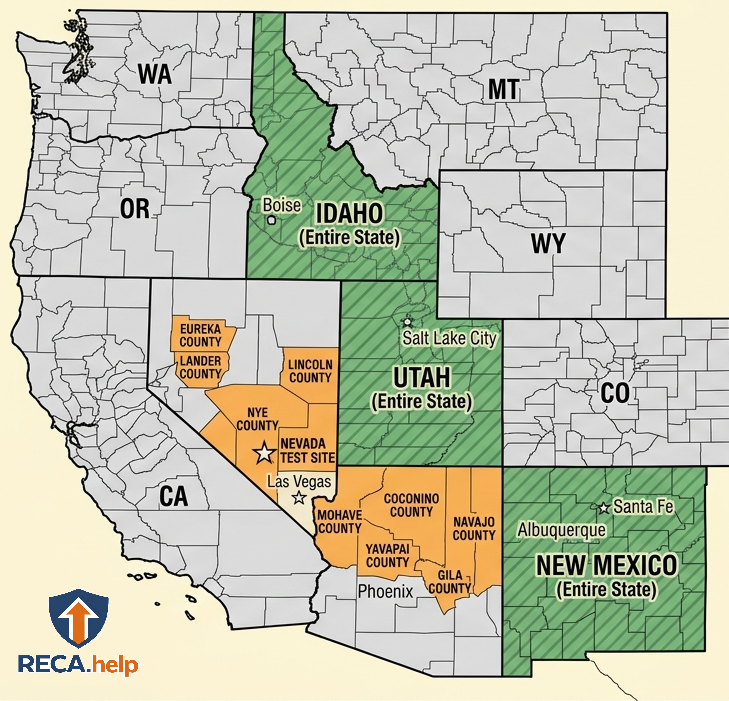
Eligible Downwinder regions based on current RECA criteria.
Qualifying Medical Diagnoses
The RECA program compensates individuals diagnosed with specific cancers. The qualifying list includes:
- Leukemia (excluding chronic lymphocytic leukemia)
- Multiple Myeloma and Lymphomas (other than Hodgkin's disease)
- Primary cancers of the: Bile Ducts, Bladder, Brain, Breast, Colon, Esophagus, Gall Bladder, Liver (unless evidence of cirrhosis/Hepatitis B exists), Lung, Nasal Pharynx, Ovarian, Pancreas, Rectum, Salivary Gland, Small Intestine, Stomach, and Thyroid.
Establishing Physical Presence & Overcoming Missing Records
Locating mid-century residency records is often the most significant hurdle when proving a claim timeline. Whether you have primary documents or need to rely on secondary sources, careful research is essential.
Navigate municipal archives and locate primary sources like property deeds and tax records. When primary records are inaccessible, learn how to utilize secondary evidence such as school yearbooks, church records, affidavits, and historical directories to build an undeniable timeline of residency.
Understanding Survivor Claims
If an eligible individual passes away before filing or receiving their payment, federal law allows their surviving family members to apply for the $100,000 compensation on their behalf. The compensation is distributed as a single lump-sum payment to the first living category of relatives according to a strict legal "order of precedence":
- Surviving Spouse: If the qualifying individual was married at the time of their passing, the surviving spouse is first in line to receive the benefit.
- Surviving Children: If there is no surviving spouse, the compensation is distributed in equal shares among all of the deceased individual's surviving children.
Filing a survivor claim requires proving the deceased family member's eligibility (medical and residency records) as well as verifying the survivor's legal relationship. Additional mandatory documentation includes a formal death certificate signed by a physician, and proof of relationship, such as a marriage certificate for a spouse or birth certificates for children.
Submitting Your Claim
It is critical to completely assemble all required documentation prior to filing your claim. Submitting an incomplete application will trigger deficiency notices and delay processing. All RECA claims must be filed before the statutory deadline of December 31, 2027. Once your evidentiary file is fully compiled, select the appropriate filing guide below:
A comprehensive guide to assembling your documentation and submitting a standard RECA Downwinder claim to the Department of Justice.
Step-by-step guidance on consolidating documentation, verifying identity, and overcoming missing marriage or birth certificates for survivor benefit applications.