1. The History: Testing in the Aleutians
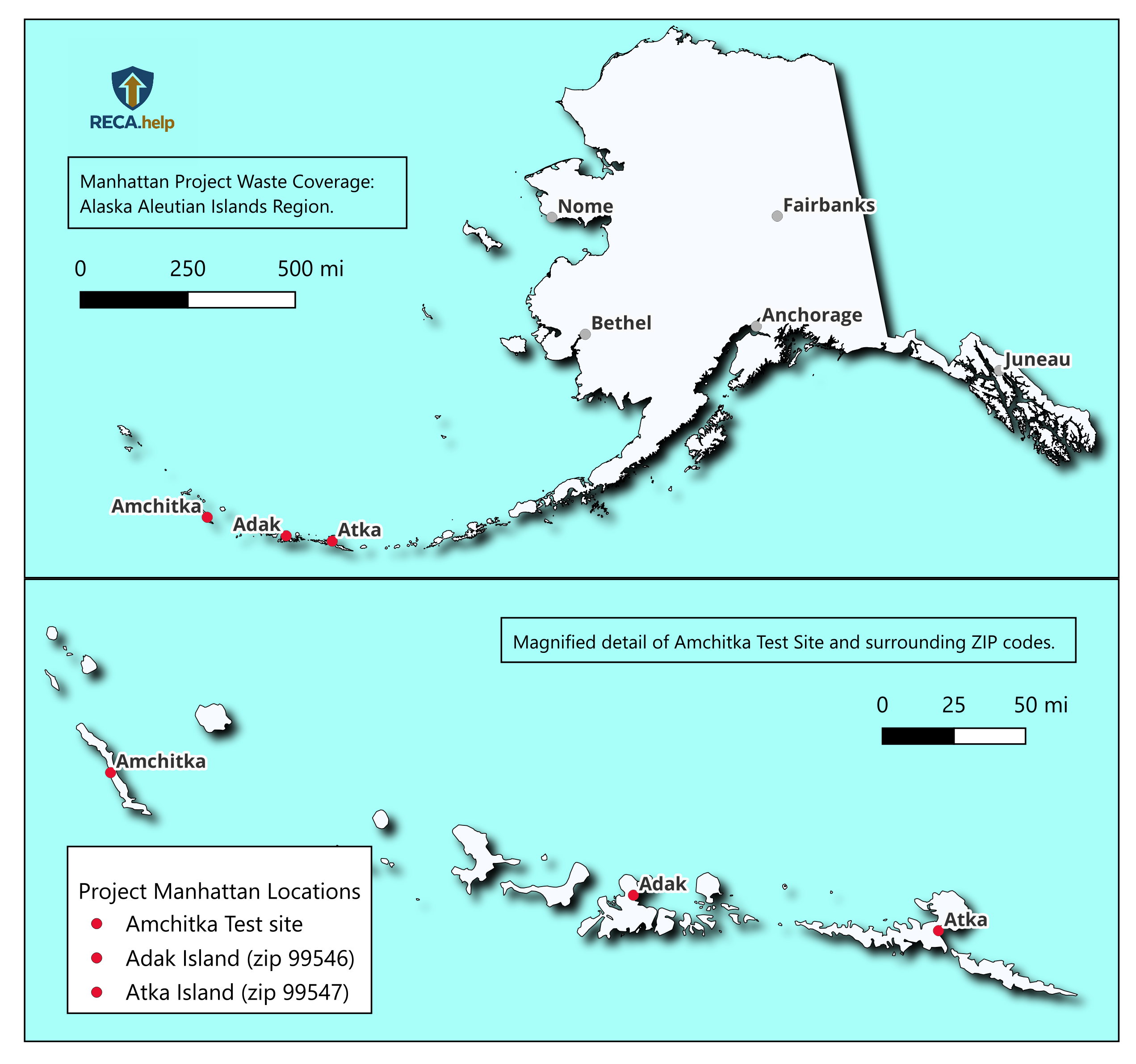
Unlike the uranium processing facilities in Missouri, Tennessee, and Kentucky, Amchitka Island was not a manufacturing site. Located near the far western end of the Aleutian Island chain, it served as a remote testing ground for the Atomic Energy Commission (AEC).
Between 1965 and 1971, the U.S. government detonated three massive underground nuclear weapons deep beneath the island: Long Shot, Milrow, and Cannikin. The Cannikin test remains the largest underground nuclear detonation in United States history. While the tests were underground, the drilling, venting, and subsequent decades of environmental remediation exposed thousands of workers and local populations to radioactive materials.
2. Eligible ZIP Codes and Populations
Because Amchitka itself had no permanent civilian town during the testing era, the geographic boundaries and affected populations look very different from mainland claims.
To qualify, you must prove 24 months of physical presence (cumulatively or consecutively) in one of the following ZIP codes:
- 99546 (Adak and surrounding areas)
- 99547 (Atka and surrounding areas)
The claimant pool for Alaska primarily consists of three distinct groups:
- Civilian Contractors: Drillers, miners, engineers, and cleanup crews hired by the AEC or private firms (such as Holmes & Narver).
- Military Personnel: Servicemembers stationed at the nearby Adak Naval Operating Base, Coast Guard detachments, and military logistical support crews.
- Indigenous Populations: Aleut/Unangax̂ communities living in the surrounding islands and relying on local marine environments for subsistence.
3. Proving Your Physical Presence
Documenting 24 months of presence in the remote Aleutians requires a targeted approach. Since original contracting firms are defunct, the DOJ relies on federal and institutional archives to establish eligibility.
| Record Type | How to Request Your Documentation |
|---|---|
| Federal Employment & Dosimetry (DOE) |
For contractor dosimetry or radiation exposure logs, contact the Department of Energy (DOE) Office of Legacy Management (LM).
|
| Official Personnel Files (NARA) |
Your Official Personnel File (OPF) acts as the definitive proof of your federal or contractor service dates.
|
| Indigenous Residency |
For Indigenous communities, local records are the most accurate proof of presence.
|
4. Archival & Vital Records
If you need to access official state records to prove your physical presence or verify family connections for survivor claims, you can contact the following offices:
| Office | Contact Information & Address |
|---|---|
| Alaska Bureau of Vital Statistics Provides certified copies of birth, death, marriage, and divorce certificates for Alaska. |
4600 DeBarr Rd, Suite 180 Anchorage, AK 99508 Phone: (907) 465-3391 |
| Alaska State Archives Official repository for historical state records. |
395 Whittier Street Juneau, AK 99801 Phone: (907) 465-2270 |
5. Religious & Parish Records
Church and parish records, such as baptismal and marriage certificates, are excellent sources for documenting physical presence, dates of birth, and family connections. Both the Catholic Church and the LDS Church have established specific resources for RECA applicants seeking historical records.
| Record Source | Details & Contact Information |
|---|---|
| Archdiocese of Anchorage-Juneau Archives For Catholic records covering the Aleutians West region. |
The Archdiocese covers the geographic area including the Aleutians and maintains sacramental records. In accordance with RECA guidelines, historical sacramental records can serve as documentation. Address: 225 Cordova Street, Anchorage, AK 99501 Phone: (907) 258-7898 |
6. Medical Requirements & Next Steps
In addition to proving your geographic presence, you must have a certified medical diagnosis of a qualifying radiation-linked illness (such as specific primary cancers, leukemia, or multiple myeloma) that occurred after your period of exposure. If you meet both the geographic and medical requirements, you can file a "Manhattan Project Waste" claim through the DOJ's portal for a $50,000 lump sum (or medical expense reimbursement if living, or a $25,000 survivor benefit if deceased).