1. The History: The Paducah Gaseous Diffusion Plant
Constructed in 1952, the Paducah Gaseous Diffusion Plant (PGDP) was a massive federal facility built to enrich uranium for the United States' growing nuclear weapons stockpile, and later for commercial nuclear reactors. For decades, it was the only operating uranium enrichment facility in the country.
While the plant provided thousands of jobs, it also produced immense amounts of radioactive material and hazardous chemicals. Over time, significant contamination spread beyond the plant's security fences. Radioactive isotopes (like technetium-99 and uranium) and toxic industrial solvents (like TCE) leached into the groundwater, contaminating residential wells, local creeks, and soil throughout surrounding communities in McCracken County.
2. Eligible ZIP Codes in McCracken County
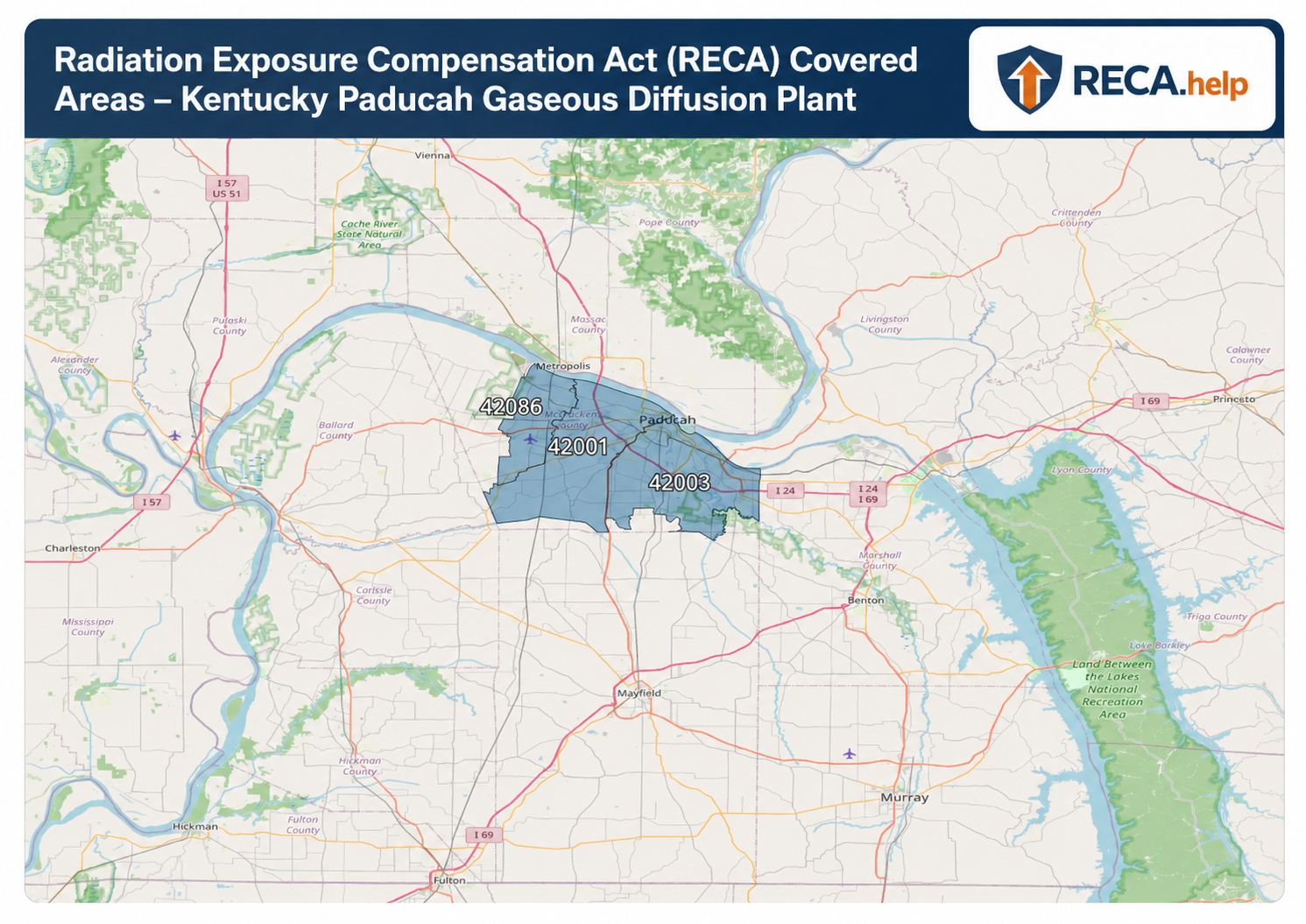
The geographic footprint for Kentucky's RECA eligibility is highly concentrated around the plant and its affected watersheds. To qualify, you must prove you lived, worked, or attended school for at least 24 months (cumulatively or consecutively) anytime after January 1, 1949, in one of the following ZIP codes:
- 42001 (Paducah)
- 42003 (Paducah / Lone Oak area)
- 42086 (West Paducah)
Note: Because the plant wasn't built until 1952, you might wonder why the eligibility date starts in 1949. The 1949 start date is a universal legal baseline set by Congress for all Manhattan Project Waste areas, ensuring no early site preparation or testing exposures are accidentally excluded.
3. Proving Your Physical Presence
Because the Department of Justice requires official documentation to prove your 24 months of physical presence, you will need to gather contemporaneous records. Here are the most effective ways for Paducah-area residents to build their claims:
| Type of Record | Where to Find It in Kentucky |
|---|---|
| Tax & Property Records |
McCracken County Property Valuation Administrator (PVA) records, local property tax receipts, or deeds establishing home ownership in the eligible ZIP codes. Contact Information for Records: • McCracken County PVA: 300 Clarence Gaines St., Paducah, KY 42003 | Phone: (270) 444-4712 |
| School Transcripts |
Official transcripts or attendance records from McCracken County Public Schools, Paducah Public Schools, or local private academies (e.g., St. Mary). Yearbooks can support a claim but are usually not sufficient on their own without a formal transcript. Contact Information for Transcripts: • McCracken County Public Schools: 300 Cumberland Avenue, Paducah, KY 42001 | Phone: (270) 538-4000 |
| Employment & Residential |
W-2s, pay stubs, state unemployment records from businesses located within the 42001, 42003, or 42086 ZIP codes, or utility bills (water, electric) sent to a residential address within the coverage area. (Again, this can be from any local business, not just the PGDP). Note: Medical records are also considered excellent proof of physical presence. See Section 6 below for detailed instructions on requesting these from regional Health Information Management (HIM) departments. |
| Public and Polk Directories |
Prior to the widespread use of digital records, historical city directories—such as Polk Directories—were the primary way to track residency. These directories list names, occupations, and home addresses year-by-year. Because they establish a concrete timeline of where someone lived during specific years, they are considered excellent proof of physical presence for RECA claims. Where to access directories: • McCracken County Public Library (Local and Family History Dept.): 555 Washington St., Paducah, KY 42003 | Phone: (270) 442-2510 |
Local Support & Advocacy: If you are struggling to find decades-old documents, the McCracken County Public Library maintains extensive local history and genealogy archives, including old city directories and phone books, which the DOJ often accepts as secondary proof of residency.
4. Archival & Vital Records
If you need to access official state records to prove your physical presence or verify family connections for survivor claims, you can contact the following office:
State laws strictly limit who can request a certified vital record (especially for the first 50 years after a birth or death). To request a record for someone else, you must generally be an immediate family member, a legal guardian, or an official representative.
Required Documentation: When ordering from any of the state agencies below, you must provide a valid government-issued photo ID and documentation proving your relationship to the person on the certificate (e.g., your own birth certificate showing them as your parent).| Office | Contact Information & Address |
|---|---|
| Kentucky Office of Vital Statistics Provides certified copies of birth, death, marriage, and divorce certificates for Kentucky. |
275 East Main Street, 1E-A Frankfort, KY 40621 Phone: (502) 564-4212 |
5. Religious & Parish Records
Church and parish records, such as baptismal and marriage certificates, are excellent sources for documenting physical presence, dates of birth, and family connections. Both the Catholic Church and the LDS Church have established specific resources for RECA applicants seeking historical records.
| Record Source | Details & Contact Information |
|---|---|
| Diocese of Owensboro Archives For records from closed Catholic parishes in western Kentucky. |
The Archives maintain a record of the diocese and its parishes. In accordance with RECA guidelines, historical sacramental records can serve as documentation. Address: McRaith Catholic Center, 600 Locust Street, Owensboro, KY 42301 Phone: (270) 683-1545 |
| Open Catholic Parishes For records from active churches. |
If the church or parish you attended is still actively operating, you will need to contact that specific open parish directly to request your baptismal, marriage, or communion certificates. |
| LDS Church Records DOJ-Authorized Residency Certificates. |
The Department of Justice explicitly recognizes records from The Church of Jesus Christ of Latter-day Saints as highly reliable proof of physical presence. The Church provides a dedicated, free service to cross-reference historical membership records and issue a formalized residency certificate for RECA applicants. Learn More: For full instructions on how to request this certificate or search historical ward records, please visit our LDS Church Records Guide. |
6. Health Information Management (HIM) & Qualifying Illnesses
To qualify for compensation under the Manhattan Project Waste provisions, you must provide certified medical documentation proving a diagnosis of a qualifying radiation-linked illness that occurred after your period of exposure.
Acceptable Qualifying Cancers
The Department of Justice recognizes the following primary cancers and illnesses for Manhattan Project Waste claims:
- Any Leukemia (if initial exposure occurred after age 20)
- Multiple Myeloma
- Lymphomas (other than Hodgkin's disease)
- Primary cancer of the thyroid
- Primary cancer of the male or female breast
- Primary cancer of the esophagus
- Primary cancer of the stomach
- Primary cancer of the pharynx
- Primary cancer of the small intestine
- Primary cancer of the pancreas
- Primary cancer of the bile ducts
- Primary cancer of the gall bladder
- Primary cancer of the salivary gland
- Primary cancer of the urinary bladder
- Primary cancer of the brain
- Primary cancer of the colon
- Primary cancer of the ovary
- Primary cancer of the liver (except if cirrhosis or hepatitis B is indicated)
- Primary cancer of the lung
- Primary cancer of the bone
- Primary renal cancer
Acceptable Medical Documentation
Medical records must be either original or certified copies (often stamped with a raised or colored seal from the issuing institution). If a seal is not available, the hospital or physician must attach a signed and dated cover letter on official letterhead stating the records are true and accurate copies. Acceptable forms of proof include:
- Pathology reports or tissue biopsies
- Operative reports
- Hospital discharge summary reports
- Physician summary reports (requires a documented ongoing physician-patient relationship)
- Autopsy reports
- Death certificates (dated and signed by a physician)
Hospital retention policies often result in records being purged after 10 to 20 years. If the facility where you were originally diagnosed no longer has your paperwork, request the records from later, unrelated procedures at different hospitals. Standard medical intake requires a complete medical history. A surgeon's pre-operative notes or a physician's summary from a recent, unpurged hospital visit will often explicitly document your past cancer diagnoses, which can serve as critical secondary proof for your claim.
Regional HIM Medical Contacts
You can request your historical medical records directly from the Health Information Management (HIM) departments of the major McCracken County hospital systems:
| Hospital System | HIM Department Contact Information |
|---|---|
| Mercy Health - Lourdes Hospital | 1530 Lone Oak Rd., Paducah, KY 42003 Phone: (270) 444-2444 |
| Baptist Health Paducah | 2501 Kentucky Avenue, Paducah, KY 42003 Phone: (270) 575-2100 |
If your original hospital records have been lost or purged, the state maintains a backup. The Kentucky Cancer Registry (KCR) operates as the population-based central cancer registry for the Commonwealth. Mandatory reporting began in 1991, and their records are highly comprehensive for qualifying cancers diagnosed from 1994 onward among Kentucky residents.
Important Notice: The Kentucky Cancer Registry explicitly does not process direct record requests from individuals or allow in-person visits. To utilize this backup, you must authorize the Department of Justice to request verification on your behalf. You can do this by checking the authorization box on Page 10 and signing the medical release on Page 14 of your official RECA claim form.
7. Frequently Asked Questions (FAQ)
What are the eligible ZIP codes for a Paducah Kentucky RECA claim?
To qualify, you must prove you lived, worked, or attended school for at least 24 months (cumulatively or consecutively) anytime after January 1, 1949, in ZIP codes 42001, 42003, or 42086.
Do I need to have worked at the Paducah Gaseous Diffusion Plant to qualify?
No, you do not need to have worked at the plant to qualify for this new RECA expansion. The 2025 "Manhattan Project Waste" category was created specifically for everyday residents, families, and students who were exposed environmentally.
How do I prove my physical presence in McCracken County?
Because the Department of Justice requires official documentation to prove your 24 months of physical presence, you will need to gather contemporaneous records. You can use McCracken County Property Valuation Administrator (PVA) records, local property tax receipts, or deeds establishing home ownership. Other acceptable documents include official school transcripts, W-2s, pay stubs, state unemployment records, utility bills, or historical city directories like Polk Directories.
What should I do if my original hospital medical records were purged?
Hospital retention policies often result in records being purged after 10 to 20 years. If the facility where you were originally diagnosed no longer has your paperwork, request the records from later, unrelated procedures at different hospitals. Standard medical intake requires a complete medical history. A surgeon's pre-operative notes or a physician's summary from a recent, unpurged hospital visit will often explicitly document your past cancer diagnoses, which can serve as critical secondary proof for your claim.
Can I request my records directly from the Kentucky Cancer Registry?
No, the Kentucky Cancer Registry explicitly does not process direct record requests from individuals or allow in-person visits. To utilize this backup, you must authorize the Department of Justice to request verification on your behalf by checking the authorization box on Page 10 and signing the medical release on Page 14 of your official RECA claim form.