1. The History: Manhattan Project Waste in Missouri
During the Cold War era, facilities like the Mallinckrodt Chemical Company refined immense quantities of uranium for the Manhattan Project and subsequent nuclear weapons programs. Specifically, Mallinckrodt began processing Belgian Congo Uranium (U235) for the first atomic bomb in 1942 at its downtown St. Louis location. By the mid-1940s, the facility ran out of space and began shipping radioactive waste to underpopulated areas north of St. Louis, including the Hazelwood Interim Storage Site (HISS) on Latty Avenue and the St. Louis Airport Site (SLAPS).
This led to severe, long-term environmental contamination. The radioactive materials were stored in bulk, directly on the ground, open to the elements, and left unattended next to Coldwater Creek until the 1970s. The area surrounding the creek consists of porous material and is riddled with underground interconnecting caves, rivers, springs, and groundwater tables, which allowed radioactive isotopes to spread easily.
The danger was compounded by a significant population boom from the 1950s to the 1970s. Construction grading for new subdivisions disturbed the radioactive materials, effectively redistributing the contamination throughout North St. Louis County. Exposed waste was even used as fill for newly created subdivision lawns. This caused chronic exposure for residents through both inhalation—as radioactive dust could travel up to 10 miles in the wind—and ingestion, as radiation leached into local farm crops, backyard gardens, and dairy supplies. Today, the government acknowledges this contamination and is working to clean up the area through the FUSRAP (Formerly Utilized Sites Remedial Action Program).
2. Eligible ZIP Codes in Missouri
The geographic footprint for Missouri's RECA eligibility covers 21 specific ZIP codes across St. Louis and St. Charles counties. To qualify, you must prove you lived, worked, or attended school for at least 24 months (cumulatively or consecutively) anytime after January 1, 1949, in any of the following ZIP codes:
- 63031
- 63033
- 63034
- 63042
- 63043
- 63044
- 63045
- 63074
- 63102
- 63114
- 63121
- 63134
- 63135
- 63138
- 63140
- 63145
- 63147
- 63304
- 63341
- 63367
- 63368
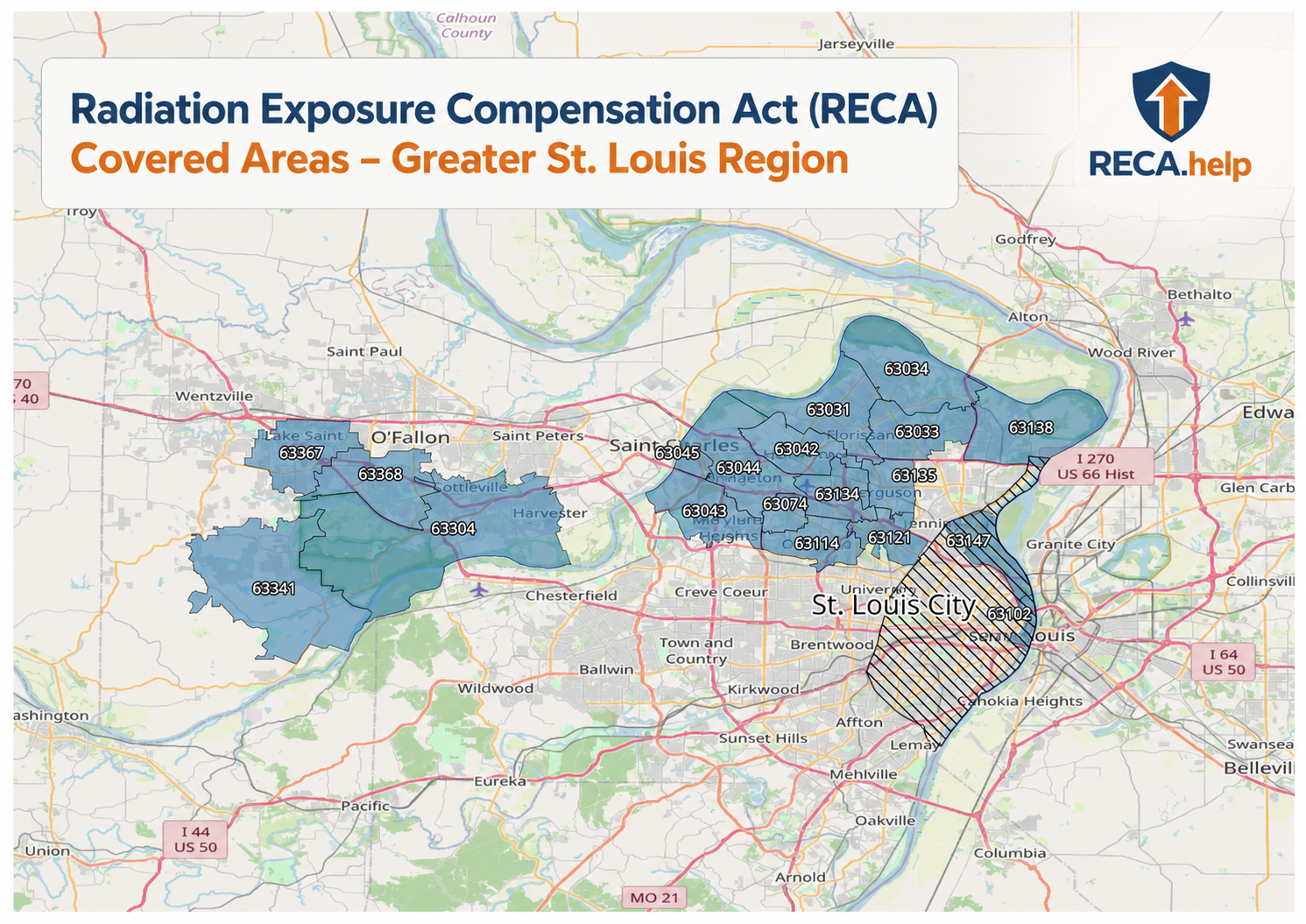
3. Proving Your Physical Presence
Because the Department of Justice requires official documentation to prove your 24 months of physical presence, you will need to gather contemporaneous records. Local Missouri governments and organizations have mobilized to help residents track down this historical proof:
| Type of Record | Where to Find It in Missouri |
|---|---|
| School Transcripts |
Official transcripts from districts like Francis Howell, Fort Zumwalt, and local St. Louis County school districts. Many local high schools (e.g., Francis Howell Central, Liberty High) and elementary/middle schools fall directly in the eligible ZIP codes. Contact Information for Transcripts: • Francis Howell School District: 801 Corporate Centre Drive, O'Fallon, MO 63368 | Phone: (636) 851-4000 • Fort Zumwalt School District: 555 E. Terra Lane, O'Fallon, MO 63366 | Phone: (636) 240-2072 |
| Voter & Tax Records |
County election authorities can provide historical voter registration records, and county assessors hold historical property tax receipts. Contact Information for Records: • St. Charles County Election Authority: 397 Turner Blvd., St. Peters, MO 63376 | Phone: (636) 949-7550 • St. Charles County Assessor: 201 N. Second St., St. Charles, MO 63301 | Phone: (636) 949-7420 • St. Louis County Board of Elections: 725 Northwest Plaza Drive, St. Ann, MO 63074 | Phone: (314) 615-1800 • St. Louis County Assessor: 41 South Central Avenue, 3rd Floor, Clayton, MO 63105 | Phone: (314) 615-2555 |
| Employment & Residential |
W-2s, pay stubs, state unemployment records, or contemporaneous utility bills sent to a residential address within the 21 ZIP codes during the qualifying time period. Note: Medical records are also considered excellent proof of physical presence. See Section 6 below for detailed instructions on requesting these from regional Health Information Management (HIM) departments. |
| Public and Polk Directories |
Prior to the widespread use of digital records, historical city directories—such as Polk Directories—were the primary way to track residency. These directories list names, occupations, and home addresses year-by-year. Because they establish a concrete timeline of where someone lived during specific years, they are considered excellent proof of physical presence for RECA claims. Where to access directories: • St. Louis County Library (History & Genealogy Dept.): Clark Family Branch, 1640 S. Lindbergh Blvd, St. Louis, MO 63131 | Phone: (314) 994-3300. Note: The library provides a direct remote look-up service where you can request a residency documentation search via their RECA Lookup Request Form. • St. Louis Public Library (Central Library): 1301 Olive Street, St. Louis, MO 63103 | Phone: (314) 241-2288 |
Local Support & Advocacy: Several local organizations provide direct assistance for navigating claims and understanding the history of the contamination:
- St. Louis County Library (History & Genealogy Dept.): Offers a dedicated, free program to track down residency evidence from historical city records. You can submit data requests online via the SLCL RECA Lookup Request Page.
Clark Family Branch: 1640 S. Lindbergh Blvd, St. Louis, MO 63131 | Phone: (314) 994-3300 - St. Charles City-County Library: Hosts a dedicated RECA resource page and informational livestreams to help residents obtain government documents.
Central Services: 77 Boone Hills Dr., St. Peters, MO 63376 | Phone: (636) 441-2300 - Just Moms STL: A leading advocacy organization offering local guidance and support to exposed families.
Contact: PO Box 1761, Maryland Heights, MO 63043 | Email: westlakemoms@gmail.com | Phone: (314) 229-4896
Facebook: Just Moms STL Facebook Page - a fantastic resource for community updates. - The Pink Angels Foundation (RECA Help Center): Provides direct scheduling for appointments and application assistance.
Location: 620 North Lafayette Street, Florissant, MO 63031 | Phone: (314) 441-4040 - Coldwater Creek - Just the Facts Please: A community Facebook group started in 2011 by residents who noticed inexplicably high incidents of cancer and disease, aiming to investigate the contamination.
4. Archival & Vital Records
If you need to access official state or county records to prove your physical presence or verify family connections for survivor claims, you can contact the following offices:
State laws strictly limit who can request a certified vital record (especially for the first 50 years after a birth or death). To request a record for someone else, you must generally be an immediate family member, a legal guardian, or an official representative.
Required Documentation: When ordering from any of the state agencies below, you must provide a valid government-issued photo ID and documentation proving your relationship to the person on the certificate (e.g., your own birth certificate showing them as your parent).| Office | Contact Information & Address |
|---|---|
| Saint Louis County Vital Records Provides certified copies of birth and death certificates for Missouri. |
6121 N. Hanley Rd. Berkeley, MO 63134 Phone: (314) 615-1720 |
| Missouri State Archives Official repository for state records of permanent value, including historical county records, military records, and census data. |
600 W. Main St. Jefferson City, MO 65101 Phone: (573) 751-3280 |
5. Religious & Parish Records
Church and parish records, such as baptismal and marriage certificates, are excellent sources for documenting physical presence, dates of birth, and family connections. Both the Catholic Church and the LDS Church have established specific resources for RECA applicants seeking historical records.
| Record Source | Details & Contact Information |
|---|---|
| Archdiocese of St. Louis Archives For records from closed Catholic parishes. |
The Archives holds records for parishes that are no longer open. They offer a specific "RECA General Parish Records Search Request" form. In accordance with RECA guidelines, they will provide a certified copy with a signature, date, seal, and an official cover letter for a $10 fee. Address: 20 Archbishop May Drive, St. Louis, MO 63119-5738 Phone: (314) 792-7020 Email: archives@archstl.org |
| Open Catholic Parishes For records from active churches. |
If the church or parish you attended is still actively operating, the Archdiocese Archives does not hold its records. You will need to contact that specific open parish directly to request your baptismal, marriage, or communion certificates. |
| LDS Church Records DOJ-Authorized Residency Certificates. |
The Department of Justice explicitly recognizes records from The Church of Jesus Christ of Latter-day Saints as highly reliable proof of physical presence. The Church provides a dedicated, free service to cross-reference historical membership records and issue a formalized residency certificate for RECA applicants. Learn More: For full instructions on how to request this certificate or search historical ward records, please visit our LDS Church Records Guide. |
6. Health Information Management (HIM) & Qualifying Illnesses
To qualify for compensation under the Manhattan Project Waste provisions, you must provide certified medical documentation proving a diagnosis of a qualifying radiation-linked illness that occurred after your period of exposure.
Acceptable Qualifying Cancers
The Department of Justice recognizes the following primary cancers and illnesses for Manhattan Project Waste claims:
- Any Leukemia (if initial exposure occurred after age 20)
- Multiple Myeloma
- Lymphomas (other than Hodgkin's disease)
- Primary cancer of the thyroid
- Primary cancer of the male or female breast
- Primary cancer of the esophagus
- Primary cancer of the stomach
- Primary cancer of the pharynx
- Primary cancer of the small intestine
- Primary cancer of the pancreas
- Primary cancer of the bile ducts
- Primary cancer of the gall bladder
- Primary cancer of the salivary gland
- Primary cancer of the urinary bladder
- Primary cancer of the brain
- Primary cancer of the colon
- Primary cancer of the ovary
- Primary cancer of the liver (except if cirrhosis or hepatitis B is indicated)
- Primary cancer of the lung
- Primary cancer of the bone
- Primary renal cancer
Acceptable Medical Documentation
Medical records must be either original or certified copies (often stamped with a raised or colored seal from the issuing institution). If a seal is not available, the hospital or physician must attach a signed and dated cover letter on official letterhead stating the records are true and accurate copies. Acceptable forms of proof include:
- Pathology reports or tissue biopsies
- Operative reports
- Hospital discharge summary reports
- Physician summary reports (requires a documented ongoing physician-patient relationship)
- Autopsy reports
- Death certificates (dated and signed by a physician)
Hospital retention policies often result in records being purged after 10 to 20 years. If the facility where you were originally diagnosed no longer has your paperwork, request the records from later, unrelated procedures at different hospitals. Standard medical intake requires a complete medical history. A surgeon's pre-operative notes or a physician's summary from a recent, unpurged hospital visit will often explicitly document your past cancer diagnoses, which can serve as critical proof for your claim.
Regional HIM Medical Contacts
You can request your historical medical records directly from the Health Information Management (HIM) departments of major St. Louis regional hospital systems:
| Hospital System | HIM Department Contact Information |
|---|---|
| BJC HealthCare (St. Louis Area) | #1 Barnes-Jewish Hospital Plaza, St. Louis, MO 63110 Phone: (314) 454-5934 |
| BJC HealthCare (St. Peters/St. Charles Area) | 10 Hospital Drive, St. Peters, MO 63376 Phone: (636) 916-9694 |
| Mercy Hospital St. Louis | 615 S. New Ballas Rd., St. Louis, MO 63141 Phone: (314) 251-4622 |
| SSM Health (St. Louis Area) | 6420 Clayton Road, St. Louis, MO 63117 Phone: (314) 768-8133 |
| St. Luke's Hospital (Chesterfield) | 232 South Woods Mill Road, Chesterfield, MO 63017 Phone: (314) 205-6186 |
If your original hospital records have been lost or purged, the state maintains a backup. The Missouri Cancer Registry (MCR) holds diagnostic records for all cancers diagnosed in the state from 1984 onward. For detailed instructions on how to authorize the DOJ to verify these records automatically, or how to request your own personal physical copy via mail or fax, please review our dedicated Missouri Cancer Registry Guide.
7. Frequently Asked Questions (FAQ)
What are the eligible ZIP codes for a Missouri RECA claim?
To qualify, you must prove you lived, worked, or attended school for at least 24 months (cumulatively or consecutively) anytime after January 1, 1949, in one of 21 specific ZIP codes across St. Louis and St. Charles counties. These include 63031, 63033, 63042, 63102, and others listed in our geography section above.
What types of cancer qualify for Manhattan Project Waste claims?
The Department of Justice recognizes numerous primary cancers and illnesses. This includes any Leukemia (if initial exposure occurred after age 20), Multiple Myeloma, Lymphomas (other than Hodgkin's disease), and primary cancers of the thyroid, breast, stomach, lung, colon, bone, and several others.
How do I prove my physical presence in Missouri?
You can establish proof of physical presence using contemporaneous documents. Acceptable records include official school transcripts, voter registration and property tax records, employment records (like W-2s and pay stubs), residential utility bills, and historical public registries like Polk Directories.
What should I do if my original medical records have been purged?
Hospital retention policies often result in records being purged after 10 to 20 years. If your original records are gone, request medical records from later, unrelated procedures at different hospitals. Because standard medical intake requires a complete history, a surgeon's pre-operative notes or a physician's summary from a more recent visit will often explicitly document your past cancer diagnoses, serving as critical proof.
How much compensation is available if my claim is approved?
If you meet both the geographic and medical requirements, an approved "Manhattan Project Waste" claim provides a $50,000 lump sum. Alternatively, this can cover medical expense reimbursement if the claimant is living, or serve as a $25,000 survivor benefit if deceased.