General Program & Eligibility
What is RECA?
The Radiation Exposure Compensation Act (RECA) is a federal law originally enacted in 1990 to acknowledge and provide financial restitution to individuals who developed specific illnesses following exposure to radiation from the United States' early nuclear weapons program. During the Cold War and World War II, atmospheric nuclear tests and uranium mining operations unknowingly exposed thousands of citizens, military personnel, and industry workers to harmful radiation. RECA operates as an alternative to litigation, allowing eligible claimants to offset medical expenses by receiving a one-time, tax-free lump-sum payment.
What was the 2025 RECA Expansion?
Thanks to years of advocacy from impacted communities, RECA was officially reinstated and significantly expanded on July 4, 2025, extending the program through June 2028. The 2025 Reauthorization Act introduced several major improvements:
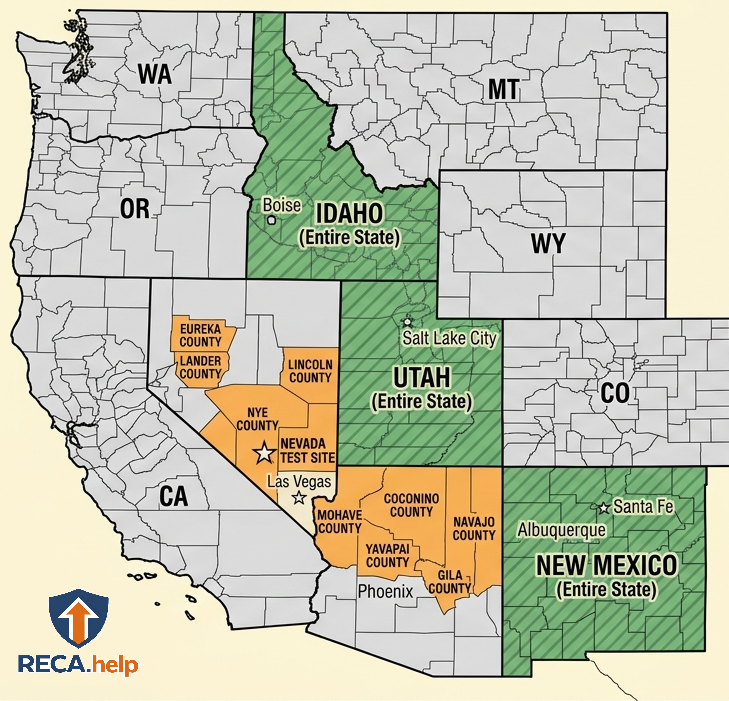
- Geographic Expansion: It expanded "Downwinder" coverage to include the entire state of New Mexico (covering the 1945 Trinity test) and widened eligible zones across Arizona, Colorado, Idaho, Montana, Nevada, and Utah.
- Manhattan Project Waste: It created a brand-new eligibility category for everyday residents who lived near historical Manhattan Project waste storage sites (such as those in Missouri, Kentucky, Tennessee, and Alaska).
- Modernized Process: The expansion introduced a streamlined digital application portal, allowed for electronic medical record uploads, simplified proof-of-residence requirements, and established a clearer appeals process.
What are the different types of RECA claims?
The RECA program is divided into four distinct claimant categories, each with its own specific eligibility requirements and compensation amounts:
- Downwinders ($100,000): Individuals who lived, worked, or attended school in designated geographic regions (downwind of the Nevada Test Site or the Trinity Site) during specific periods of atmospheric nuclear testing and later developed a qualifying cancer. For more specific information, please see our Downwinder Information Page.
- Onsite Participants ($100,000): Military personnel or civilians who were physically present onsite at or within a government installation during a United States atmospheric nuclear test (excluding Hiroshima and Nagasaki).
- Uranium Workers ($100,000): Individuals who were employed as uranium miners, millers, ore transporters, core drillers, or remediation workers in covered states for at least one year between January 1, 1942, and December 31, 1990.
- Manhattan Project Waste ($50,000 or Medical Expenses): A new category for individuals who lived, worked, or attended school for at least two years after January 1, 1949, in specific ZIP codes contaminated by Manhattan Project radioactive waste. Detailed eligibility criteria can be found on our Manhattan Project Waste Claims Page.
What cancers and conditions are eligible for compensation?
The eligible conditions depend on the claimant category.
- For Downwinders, Onsite Participants, and Manhattan Project Waste: Eligible primary conditions include Leukemia (except chronic lymphocytic leukemia), Multiple Myeloma, Lymphomas (other than Hodgkin’s disease), and primary cancers of the Thyroid, Breast, Lung, Stomach, Colon, Esophagus, Small Intestine, Pancreas, Bile Ducts, Gall Bladder, Liver, Kidney, Urinary Bladder, Brain, and Ovary.
- For Uranium Workers: Covered occupational conditions include primary lung cancer, fibrosis of the lung, pulmonary fibrosis, silicosis, pneumoconiosis, cor pulmonale, renal cancer, and chronic renal disease (including nephritis).
Are RECA payouts subject to income or estate taxes?
No. RECA compensation payments are legally classified as federal tax-free restitution. Payouts do not need to be reported as taxable income on individual 1040 tax returns, nor are they subject to federal estate taxes.
How long does it take to receive payment once a claim is submitted?
By law, the Department of Justice (DOJ) operates under a statutory 12-month window to process and adjudicate claims once received. Following approval, the U.S. Department of the Treasury typically disburses funds within 6 to 8 weeks after issuing the formal Letter of Acceptance.
What is the deadline to file a RECA claim?
Under the 2025 RECA Reauthorization Act, the program has been extended with strict statutory deadlines:
- Final Filing Deadline: All initial claims (DOJ Form CIV-1) must be submitted and received by the Department of Justice on or before December 31, 2027.
- Medical Expense Documentation: For claimants seeking reimbursement for out-of-pocket medical expenses (such as those in the Manhattan Project Waste category), all related medical billing documentation must be submitted by December 31, 2028.
- Program Termination: The RECA Trust Fund is scheduled to terminate completely on December 31, 2028.
Downwinder Claims
For a deeper dive in to research strategies for locating the mid-century residency and medical records required to file a successful RECA Downwinder claim, please review our comprehensive guide on Downwinder Claims: Proving Eligibility.
Who qualifies as a Downwinder?
Downwinders are individuals who were physically present in designated geographic regions during specific periods of atmospheric nuclear testing at the Nevada Test Site or Trinity Site, and subsequently developed a qualifying cancer. Required presence windows include:
- State of New Mexico: Physical presence for at least one year between September 24, 1944, and November 6, 1962.
- Designated Affected Areas (AZ, NV, UT, ID): Physical presence for at least one year between January 21, 1951, and November 6, 1962, OR continuous presence for the 32-day period between June 30, 1962, and July 31, 1962.
What geographic areas are covered under Downwinder rules?
Claimants must establish continuous or cumulative physical presence in one of the following designated areas:
- Full States: Idaho, New Mexico, and Utah.
- Arizona Counties: Apache, Coconino, Gila, Mohave, Navajo, and Yavapai.
- Nevada Counties: White Pine, Nye, Lander, Lincoln, Eureka, and Clark (townships 13 through 16, ranges 63 through 71).
Manhattan Project Waste Claims
For a deeper dive in to research strategies for locating residency and medical records required to file a successful RECA Manhattan Project Waste claim, please review our comprehensive guide on Manhattan Project Waste Claims.
What is the Manhattan Project Waste category?
Established during the 2025 RECA expansion, this new category provides restitution to everyday citizens who developed a qualifying illness after living, working, or attending school near specific sites used for the storage or disposal of radioactive waste generated by the Manhattan Project.
Who qualifies under the Manhattan Project Waste rules?
To be eligible, an applicant must meet two primary requirements:
- Residency Requirement: The individual must establish physical presence (living, working, or attending school) for at least two years after January 1, 1949, within one of the designated affected ZIP codes.
- Medical Requirement: After the qualifying period of presence, the individual must have developed a "specified disease," which includes various primary cancers (such as breast, thyroid, lung, colon, and brain cancer), leukemia (if exposure began after age 20), multiple myeloma, and non-Hodgkin's lymphomas.
What specific ZIP codes are eligible for Manhattan Project Waste claims?
The law defines "affected areas" specifically by ZIP code in four states. Eligible ZIP codes include:
- Missouri (St. Louis Area): 63031, 63033, 63034, 63042, 63043, 63044, 63045, 63074, 63102, 63114, 63121, 63134, 63135, 63138, 63140, 63145, 63147, 63304, 63341, 63367, 63368.
- Tennessee (Oak Ridge Area): 37710, 37716, 37719, 37748, 37763, 37769, 37828, 37829, 37830, 37831, 37840, 37845, 37854, 37887.
- Kentucky (Paducah Area): 42001, 42003, 42086.
- Alaska (Amchitka): 99546, 99547.
What is the compensation amount for a Manhattan Project Waste claim?
Compensation amounts depend on the status of the affected individual at the time the claim is filed:
- Living Individuals: The claimant is entitled to a base payment of $50,000, or reimbursement for all documented, out-of-pocket medical expenses related to the illness that were not covered by insurance or government programs—whichever amount is greater.
- Deceased Individuals: If the affected individual has passed away, a fixed payment of $25,000 is available to the surviving spouse. If there is no surviving spouse, the $25,000 is divided equally among surviving children.
Is there a deadline to file for Manhattan Project Waste?
Yes. Like all RECA claims under the 2025 expansion, initial claims must be submitted to the Department of Justice by December 31, 2027. However, if a living claimant is seeking reimbursement for medical expenses rather than the $50,000 base payment, all supporting medical billing documentation must be submitted by December 31, 2028, prior to the Trust Fund's termination.
Medical Evidence & Documentation
What medical records do I need to prove my diagnosis?
To prove a qualifying diagnosis, the Department of Justice requires certified medical documentation. You do not need to submit your entire medical history; only records directly verifying the specific compensable illness. Preferred documentation includes:
- Pathology Reports or Tissue Biopsies: This is the strongest form of evidence.
- Operative Reports: Detailed notes from a surgical procedure.
- Hospital Discharge Summaries: Summaries noting the diagnosis upon release.
- Physician Summary Reports: An official summary from your treating oncologist or physician.
- Death Certificates: Only acceptable as primary medical proof if it explicitly lists the qualifying cancer as the cause of death and is signed by a physician.
What if my original medical records were purged or destroyed?
If you or your hospital no longer possess the original pathology reports (which is common for older diagnoses), the RECA program has built-in safety nets. The DOJ can verify diagnoses directly through State Cancer and Tumor Registries (such as the Utah Cancer Registry or New Mexico Tumor Registry). Claimants can authorize the DOJ to contact these registries on their behalf by checking a specific box on the claim form. These registries respond to official DOJ research requests as a backup when physical records are unavailable.
How should medical records be formatted for submission?
With the modernized 2025 digital portal, claimants are encouraged to submit their essential, certified medical records—such as pathology or biopsy reports—in a digital PDF format. This significantly streamlines the online filing and review process. If filing a physical paper claim, you must submit certified copies; photocopies are generally insufficient unless certified by the issuing institution.
Besides medical records, what documents prove I lived in an affected area?
You must prove physical presence (residency, employment, or schooling) during the statutory timeframes. If you lack a single, continuous document, you can layer multiple sources to establish your timeline. Acceptable documents include:
- Property tax rolls and deeds.
- School yearbooks, transcripts, or directories.
- Employment records or W-2s.
- City directories and U.S. Census reports.
- Voting records.
- Personal letters or envelopes with postmarks.
While state archives and historical directories are essential tools for tracking down these records, remember that the DOJ requires certified copies or original documents unless you are utilizing the electronic filing portal.
Survivor Claims & Beneficiary Hierarchy
For a deeper dive in to filing a RECA Surviors Claim please review our comprehensive guide Guide to Filing a RECA Survivors Claim.
Can I file a claim if my affected family member has passed away?
Yes. If the individual who was exposed to radiation and developed a qualifying illness has died, their eligible survivors may file a claim on their behalf. The RECA program establishes a strict statutory hierarchy for who can claim these benefits.
What is the statutory beneficiary hierarchy?
The Department of Justice mandates that survivor claims be paid in the following strict order of priority. If a beneficiary in a higher category is alive, no one in a lower category may file:
- Surviving Spouse: Must have been married to the affected individual for at least one year immediately prior to their death.
- Surviving Children: If there is no eligible surviving spouse, all natural, adopted, or stepchildren share the compensation equally.
- Surviving Parents: If there are no eligible spouses or children.
- Surviving Grandchildren: If there are no eligible spouses, children, or parents.
- Surviving Grandparents: If there are no beneficiaries in any of the above categories.
If there are multiple surviving children, do we each file our own claim?
No. The Department of Justice requires that all eligible siblings be consolidated into a single, unified claim. Individual, separate claims filed by siblings will be rejected. You must designate a single Lead Claimant to create the account, initiate the claim, and manage the documentation on behalf of all the children.
Do all siblings need to use the electronic portal?
While the Lead Claimant manages the primary application through the digital portal, RECA rules allow for alternative signature routing to prevent a portal-only dependency. The Lead Claimant can print out the required signature pages, have their siblings physically sign them, and upload the signed documents into the centralized digital claim.
What happens if a sibling is uncooperative or missing?
You cannot simply omit a sibling to expedite the claim. The DOJ actively verifies family records. If the DOJ discovers an omitted eligible sibling, the claim will be suspended or denied. If a sibling is genuinely missing or estranged, you must provide a signed statement detailing the exhaustive efforts made to locate them. The DOJ will ultimately hold that sibling’s share in trust.
What specific documents do survivors need to provide?
In addition to proving the deceased individual's physical presence and medical diagnosis, survivors must prove their relationship. This typically requires:
- The death certificate of the affected individual.
- The claimant's birth certificate (or marriage certificate for spouses).
- Divorce decrees or death certificates for any previous marriages of the affected individual (to prove the current marriage was valid).
- Death certificates for any siblings who would have otherwise been eligible beneficiaries.
Claim Assistance & Representation
For an objective look at whether you need legal representation, or if you can successfully compile and file your claim independently, please review our comprehensive guide Do I Need an Attorney for a RECA Claim.
Do I need an attorney to file a RECA claim?
No. The RECA program was intentionally designed to be non-adversarial, meaning you are not suing the government. The DOJ evaluates claims based on strict eligibility criteria, not litigation. You are perfectly entitled to file a claim yourself or with the help of a non-attorney consultant.
How much can an attorney charge me if I do hire one?
Federal law strictly limits how much an attorney can charge you for a RECA claim. These caps protect claimants from predatory legal fees:
- Initial Claims: An attorney may charge a maximum of 2% of your total compensation for an initial filing (e.g., $1,000 on a $50,000 claim, or $2,000 on a $100,000 claim).
- Denied Claims: If your initial claim is denied and an attorney is required to resubmit it, they may charge a maximum of 10% of the final compensation.
Note: Attorneys may also charge for actual "out-of-pocket" costs (like postage or ordering medical records), but these expenses should be discussed with them in advance.
How does RECA.help assist with claims?
RECA.help is an independent consulting resource designed to help individuals navigate the "heavy lifting" of successful claim documentation. While we do not provide legal advice or formally represent you before the DOJ, we assist claimants in tracking down missing documents, understanding their eligibility status, layering physical presence records, and organizing their submission package to minimize the chance of rejection.
The Science and Politics of Exposure
For a deeper dive into the historical context and meteorological factors behind atmospheric testing, please review our comprehensive guide on The Science and Politics of Exposure.
Why are testing dates like Operation Plumbbob and Operation Dominic II significant?
Eligibility centers on major nuclear testing series at the Nevada Test Site. Campaigns like Operation Plumbbob (1957) and Operation Dominic II (1962) produced heavy local fallout due to high-yield detonations and shifting weather patterns, resulting in significant atmospheric releases over civilian communities.
What was the "1958 Moratorium"?
The 1958 Moratorium was a voluntary temporary suspension of atmospheric nuclear testing agreed upon by the United States and the Soviet Union. The rush to test weapons immediately prior to the pause (Operation Hardtack II) and during the 1962 testing resumption often forced tests to proceed during unfavorable meteorological conditions, maximizing fallout deposition downwind.
How did fallout enter the local food supply?
Primarily through the "Milk Pathway." Radioactive isotopes such as Iodine-131 and Strontium-90 settled on open pastures consumed by dairy cows. Contaminated milk was then quickly distributed to local markets, concentrating radiation in the developing thyroids and bone structures of children.